

Help Make it Rain for Math52!
Hi everyone,
If you follow me on Twitter, you may have noticed some activity over the past week in regards to a new Kickstarter project, Math52. From the creators of Mathalicious, this campaign has set the ambitious goal of raising $164,000 to help transform the way mathematics is taught in our schools. Every week for a year, they will release a video aimed at exploring mathematics through everyday questions - the types of questions that will immediately connect with students, and help motivate them to understand the math required to provide a reasonable answer. But don't believe me, check out this video!
The team has raised over $12,000 in a week. This is amazing, but it's not quite on track for them to reach their goal. So if you give a hoot, please consider donating to this most worthy of causes. Even better, if you have some wealthy friends, get them to donate too (friends of Bill Gates, I am speaking to you!).
If you can't spare the change, then please consider spreading...
Run for the Ranking
This Saturday, folks from all over the country will be tuning in to the 138th Kentucky Derby. In fact, this year the Kentucky Derby falls on the same day as Cinco de Mayo; undoubtedly the result of this intersection will be a plethora of parties celebrating the melting pot that is America (tacos and mint juleps make for a wonderful combination, I'm sure).
Whenever racing comes up, mathematics can't be far behind. Gambling is always a popular topic: how are the odds for the different racers determined, for example? But this is a question I will save for another time. Today, inspired by horse racing in particular, I'd like to discuss the following classic logic puzzle.
Suppose you have 25 horses and a 5 lane race track. You have no way to record the finishing times of the horses, but you can race up to 5 horses on the track at once and see how quickly the horses finish relative to one another. What's the minimum number of races needed to find the three fastest horses?If you had...
CNN Light Years guest post: Data: It's how stores know you're pregnant
In honor of this year's Mathematics Awareness Month, titled "Mathematics, Statistics, and the Data Deluge," I've contributed an article to CNN's Light Years blog on how corporations might use big data to infer personal details about its customers. Mostly this was inspired by the recent New York Times investigation on how Target collects and uses customer data. Here's an excerpt:
Whether you are trying to make the best decisions for your fantasy baseball league, looking to capitalize on an opportunity in a fluctuating stock market or simply filtering through the results of a Google search, it is hard to deny that we are surrounded by more data now than ever before. As such, the task of organizing and drawing conclusions from data can be a challenge, but thankfully mathematics can, in many cases, rise to the occasion.Want to read more? Click here to go to the story!
How Powerful is the Pyramid?
My love of NBC comedies has, by now, been well established. Today I'd like to return to The Office, for although Steve Carrell's absence may have hurt the ratings, it certainly has not diminished the potential for the show to inspire some mathematical thinking.
If you have not been watching recently, this season marked the debut of the company's first ever tablet computer, dubbed the Pyramid. The Pyramid made its first appearance early in the season (and was also featured in on Wired), and has since been joined by a smartphone counterpart known as the Arrowhead. Here's an image of Dwight touting the new tablet.

On the face of it, the tablet is ridiculous (this fact is eventually sort of addressed later on in the season). Who wants to use a triangular shaped tablet to look at pictures or watch movies? The reason I bring this up is that from a strictly mathematical standpoint, there are reasons to view the design with quite a bit of skepticism.
Why is this the case? Well, let...
Gender Gap Infographic
As we head into the final days of March, I'd like to share with you the following infographic sent to me by a reader. It collects some interesting (and depressing) data on women in STEM (Science, Technology, Engineering, and Mathematics) careers.

Created by: Engineering Degree
While I don't necessarily put a lot of stock into the opening IQ numbers (see here and here for examples of problems with IQ testing), and I'm not sure if the data on course load in the first part is statistically significant, the data in the latter parts is quite compelling. I've discussed the psychological component of the gender gap before, but the data in the second section of this infographic provides more evidence to the claim that psychology and cultural influences, rather than biology, is behind the gender gap we see in the sciences.
Of course, anytime someone with the aptitude is dissuaded from pursuing a technical career, it is unfortunate. When a large number of people with the aptitude don't pursue...
The Probability Games
Though we are still a few months away from the start of the summer blockbuster season, the scuttlebutt is that The Hunger Games, opening this weekend, is expected to do huge business (and by huge, I mean upwards of $100 million). Based on the 2008 Suzanne Collins book of the same name, this property is the hottest new thing in the realm of young adult fiction, and in this post-Harry Potter, nearly-post-Twilight era of cinema history, the timing could not be better for movie executives. The book is the first of a trilogy, so whether you like it or not, these films will be with us for the next few years.

Cover image for the book.
If you have not read the book, or have no idea what I'm talking about in general, a trailer for the film can be found here (sorry, embedding has been disabled for the video). The story takes place sometime in the future, many years after a war that has seemingly decimated the population. The United States is now broken into twelve districts, all under control...
CNN Light Years guest post: Why a different voting system might be better
Hi Everyone,
In an attempt to spread the joy and cheer of mathematics to a broader audience, starting this month, I will occasionally be writing articles for CNN's new science and technology blog, Light Years. Fear not, most of my content will still be appearing at Math Goes Pop, and every time one of my guest posts goes live, I will let you know about it here as well. Today the topic is voting systems, something I have discussed on this blog before. Here's a piece of the intro to pique your interest:
When the results of an election (primary or otherwise) run counter to our desires, it is easy to scapegoat the political process. The right person didn't win, we may argue, because the system itself is broken. The two-party system, for example, is sometimes cited as a leading cause of the current dysfunction in Washington. But perhaps much of what ails the political climate comes from an underlying mathematical dilemma in the way we determine the winners of our elections. The mathematics...
Pi Day vs. Half Tau Day
By now my views on Pi Day are well documented (see earlier posts from 2011 and 2009 if you're curious). Recently, though, I've decided to try to be a little less curmudgeonly when it comes to math holidays. Consequently, while it would be easy to provide snarky commentary on articles with particularly egregious mathematical errors, this year I will try to restrain myself.
As I've said before, one of my biggest problems with Pi day is that the activities are, for the most part, a little ridiculous, and don't actually do anything to better the general populace's understanding of mathematics. Last year, I explained why contests involving the recitation of digits of π are silly, so this year I'd like to offer an alternative. Why not use the day as an opportunity to debate with students the relative merits of π and τ?
Of course, I'm talking about more than Greek letters here; I'm talking about what these letters represent, at least in certain circles (no pun intended). π, the golden...
Shameless Self Promotion #3
Hi everyone,
A while back I was asked to contribute an essay to a book on mathematics and popular culture. I'm pleased to announce that this book is now available for purchase! There are some great essays in this book - I'll let you decide how mine stacks up with the rest - and it also features a foreword by Keith Devlin, a Stanford University mathematician who you may know as NPR's Math Guy.
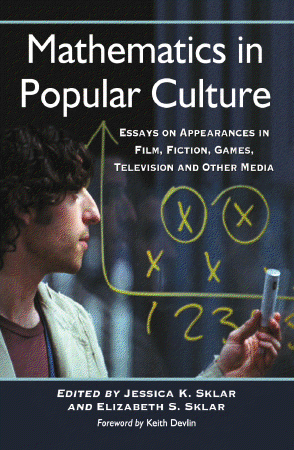
I suggested they use my face instead, but they respectfully declined.
The price of entry is a little steep ($45), but if you're someone interested in buying many copies (maybe you are a teacher, or maybe you just have a huge crush on David Krumholtz), I can get you a discount on bulk orders.
To whet your appetite, the title of my essay is Counting with the Sharks: Math-Savvy Gamblers in Popular Culture. Here's the abstract:
While mathematicians in pop culture are often portrayed as misanthropic savants who may or may not be insane, films like 21 have helped usher in a new stereotype: the...
And the Award for Best Voting System Goes to...
Last year, the Center for Election Science wrote up a quick blog post on the Oscars to motivate a discussion of voting reform. Since 2009, the Oscars have used Instant Runoff Voting (IRV) to decide the winner of the prestigious Best Picture award, but there is growing backlash against this voting system because of a number of strange properties it possesses. For example, the winner of an IRV election may not be the most favored candidate among the voters; for another strange example, it can sometimes be to your advantage to rank your preferred candidate last instead of first. Here's a video explaining some of these weird features:
Instead of using IRV, a strong argument could be made for using Score voting (also known as Range voting). I've discussed these voting systems before (see here for a discussion of the 2010 Oakland mayoral race, for example), so I will spare the details; the interested reader can find out more about Range Voting here, and one can find a direct comparison...
Page 4 of 20